


The daily minimum wage in Mérida is $315 pesos roughly $18 USD. After taxes, child support, and a bare-bones monthly budget, a waiter’s guaranteed take-home salary is $1,437 pesos a month. Here’s what that actually means, and why tipping 15–20% isn’t generosity, it’s basic economics.
A note before we begin: the numbers in this article were reported voluntarily by 15 different waiters working at similarly-sized restaurants in Centro, where the clientele is a mix of tourists from around the world, expats, and locals. These are real numbers from real people. I’m sharing with their permission and with the goal of replacing assumptions with facts.
What We Don’t Think About When We Sit Down to Eat
You’ve had a lovely evening. The food was good, the drinks were cold, the conversation flowed. The bill arrives, let’s say $900 pesos for two people, and you do the quick mental math, leave something on the table, and head out into the warm Mérida night.
What happens after you leave?
Most people never think about it. Most people don’t know that the moment they walked out the door, the financial calculus of the person who served them shifted either toward stability or away from it based entirely on what they left behind.
This article is about what happens after you leave. It’s about the math behind the meal, and why the number you write on that slip of paper or the coins you leave on the table is not a small thing.
The Starting Point: What a Waiter Actually Earns in Mérida
Let’s start with the baseline that most visitors and even long-term expats don’t know.
Mexico’s minimum daily wage in Mérida is $315 pesos (approximately $18 USD) per day. That is not a per-hour rate. That is a full day’s pay for a minimum of 8 hours. Most waiters work shifts of 10, 12, and even 14 hours.
For a waiter working six days a week, the gross weekly salary comes to $1,890 pesos. After taxes, that number drops to $1,795 pesos per week, or $7,182 pesos per month.
Hold that number. We’ll come back to it.
What It Costs to Simply Exist in Mérida
One of the great myths about life in Mexico, one that attracts visitors and shapes how they behave when they arrive, is that it’s cheap to live here. And compared to Los Angeles or Toronto or London, yes, Mérida is more affordable. But “more affordable” is not the same as “inexpensive,” and it is certainly not the same as “inexpensive on a minimum wage salary.”
And guess what? We experience inflation here just like everyone else.
Here is what a basic, no-frills life costs a service industry worker in Mérida every month. All figures in Mexican pesos and is for ONE PERSON:
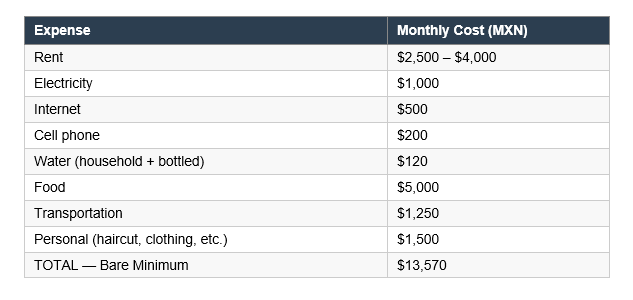
This is the absolute bare minimum. There is no vacation fund in this budget. No savings account. No money set aside for emergencies, household repairs, or the kind of unexpected costs that life has a habit of delivering at the worst possible moments. This is the cost of existing of shelter, food, getting to work, and looking presentable enough to keep the job.
$13,570 pesos per month to survive.
Now let’s go back to that take-home salary of $7,182 pesos.
The guaranteed monthly salary covers just 53% of the bare minimum cost of living. Before a single peso of child support. Before a single unexpected expense. Before anything goes wrong.
This is why tips are not a bonus. They are the other 47% and then some.
The Full Picture: Salary + Tips
The same group of waiters who shared their expenses also shared their tip averages. Across 15 servers working at similar Centro restaurants, places where the clientele is a real mix of tourists from every corner of the world, expats of varying tenure, and local Meridanos, the average weekly tip income came to $4,650 pesos.
Over four weeks, that’s $18,600 pesos per month in tips.
Add the monthly net salary:

Subtract the cost of living:
$25,782 – $13,570 = $12,212 pesos remaining.
At first glance, that looks like breathing room. But we’re not done.
When There Are Children: The Numbers Get Very Real
Child support in Mexico is calculated as a percentage of the worker’s net salary not their total income, and not their tips. The law sets the rate at 50% of net salary for one child and an additional 30% for a second child.
On a net monthly salary of $7,182 pesos:

$1,437 pesos per month. Approximately $82 USD in guaranteed income.
The rest which is the ability to pay rent, eat, get to work, keep the lights on depends entirely on tips. Every single shift. Every single table. Every single bill that lands in front of a guest who may or may not understand what their decision means.

Most Mexicans Still Live with Their Families
These numbers explain something that many expats notice but few fully understand: the vast majority of working-age Mexicans in the service industry live with their parents, their extended families, or multiple roommates. It is both cultural and a necessity. While many would love to live on their own, for most it’s not possible.
Living alone or as a single parent on a service industry salary in Mérida is, by the math, nearly impossible unless you’re a manager, a captain, or working in a high-volume tourist establishment where tips are consistently strong. For the average waiter at the average Centro restaurant? You share a home because you have to.
This is not a complaint. It is context. And it matters when your food is delivered by a waiter who has already worked eight hours and still has four hours to go.
The Tip-Out System: How a Bad Tip Becomes Worse
Here is the piece of the puzzle that most people even people who consider themselves good tippers don’t know.
Just like in the United States, waiters in Mérida don’t keep 100% of their tips. They tip out. This means a percentage of what they earn is redistributed to the other staff members who supported the service. It’s easy to identify if the restaurant you choose has a tip out requirement. Hostess? Bartender? Runner (the person who delivers your food)? Dishwasher? The more people helping the waiter, the more people share in the tips.
The average tip-out in Mérida starts at 6% and reaches 10% at fine dining establishments such as steakhouses, upscale restaurants with sommeliers, and anywhere with a full support staff working behind your experience.
Let’s do the math on a low tip:
A guest leaves a 5% tip on an $800 peso bill. That’s $40 pesos.
If the waiter’s tip-out obligation is 6%, they owe $48 pesos to the support staff regardless of what they personally received.
They just paid $8 pesos out of their own pocket to serve that table.
This is not hypothetical. It happens on a regular basis, as reported by the waiters who participated in providing information for this article.
The Math of a Generous Tip: What It Actually Changes
Let’s look at the same $800 peso bill. A very ordinary dinner for two in Centro. At different tip levels across both tipping environments.
Standard restaurant (6% tip-out):
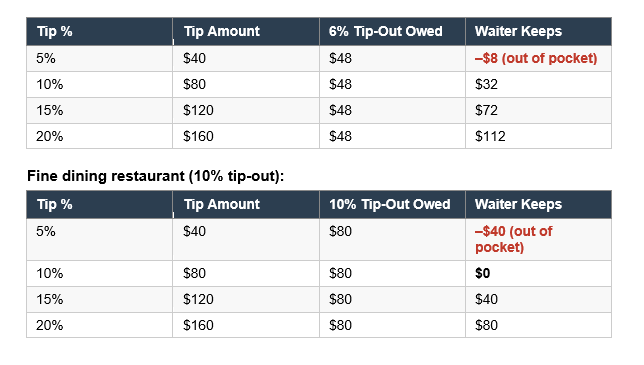
Read that fine dining column again. A 10% tip at a steakhouse means your server walks away from that table with nothing. Zero. And anyone who tipped less sent their server home having paid to wait on them.
This is the reality at high-end establishments in Mérida, where the very guests most likely to run up a large bill are also, statistically, among the most likely to undertip because they adjust their normal tipping percentage due to the fact it is Mexico.
The difference between a 5% tip and a 20% tip on a single $800 peso table is $120 pesos (about $7 USD). For the guest, that is one cup of coffee at Starbucks. For the waiter, depending on where they work, it is the difference between leaving a shift $40 pesos in the hole or $80 pesos ahead.
Add one more surprise . . . if the shift they work ends too late to get the night bus, they are forced to take a taxi which is 10x more expensive. They may not have made enough money that evening to pay for the taxi home.
Multiply that across every table on a full shift. Across a full week. Now you begin to understand why tips are critical.
What’s Actually Expected and What’s Become Inexcusable
There is a range of tipping behavior in Mérida that I’ve observed over many years, and I’ll be honest with you about all of it. If this offends you, then I apologize in advance. This is not meant to be offensive. It is meant to be a wake up call for those who are still living in an outdated mentality because it is severely affecting the service industry as a whole.
Some tip 20% without a second thought. They’ve done their research, they understand the economics, and they tip accordingly. These people are wonderful and the service industry notices them.
Some visitors tip 10–15% because that’s “what they were told” or because they’re calibrating against Mexican standards from decades ago. This is understandable, but it needs to change. The old standard from a few pesos to 10% belongs to a different era; a Mérida from past times.
And then there are the visitors, more common than you’d think, who leave a handful of loose coins on a bill of $1,000 pesos (outdated thinking and actually the height of rudeness). Who tip in U.S. dollars because it “seems more valuable” (this creates a hardship for the waiter who may not even be able to exchange dollars to pesos). Who tip nothing at all because in their home country, that is the custom (the vast majority of Europeans don’t tip at all).
That last group causes real harm. Not out of malice. But out of ignorance that has real-world consequences for real people with real expenses and real children.
The standard, as of now, in Mérida, is this:
• 15% is the floor. The absolute minimum for standard service, at any establishment.
• 20% is the goal. This is what makes a meaningful difference.
• More than 20% is always welcome for exceptional service, for a long sobremesa*, for a server who has taken care of you with genuine attention and warmth.
A Word About Culture
Mérida is a genuinely international city. Its dining rooms hold people from a dozen countries on any given night. Canadians and Americans, yes, but also Europeans, South Americans, and visitors come from parts of the world where tipping has never been a standard practice.
Mexican Nationals represent the majority of tourists coming for the cultural events, museums, archaeological sites, and, of course, the gastronomy.
Let me be clear, there is no malice in this article. Customs are real, and transplanting yourself or visiting a new country means recognizing there are going to be things that you don’t know.
But here is the thing: when you sit down in a Mérida restaurant, you have stepped into an economy with specific, real conditions. The fact that you don’t feel that you should tip the same as in your home country does not change what your server needs to cover their expenses. The cultural context you brought with you doesn’t travel to their side of the table.
Learning to tip and tip well is part of what it means to participate respectfully in this community. Whether you’re here for a week or a decade, it matters.
Final Thoughts
I am not a neutral observer on this topic. Angel has been in the service industry for 2 decades. We eat at these restaurants. We know people on both sides of the table. We have sat with the discomfort when our dinner companions remark that a tip of 10% is enough. They don’t understand that, by the math above, leaves their server worse off for having served them.
This article isn’t meant to shame anyone. Shame doesn’t change behavior; information does. What I want you to walk away with is a clear, specific understanding of what tipping well actually means in this context. Not in the abstract, but in pesos, per month, per family.
$1,437 pesos. That’s what the paycheck guarantees after obligations. Everything else is you.
Tip 15%. Tip 20%. Tip in cash, in pesos, every time. And if you’ve been in this city for years and you’re still tipping 10% because “that’s what people do” then it’s time to update your math.
The people who serve this city deserve better than the benefit of our ignorance.
*Sobremesa is a Spanish and Latin American tradition of lingering at the table after a meal to converse, relax, and connect with dining companions. Literally translating to “over the table,” it involves sharing stories, coffee, or drinks, often lasting for hours, and is considered a key cultural ritual for fostering social bonds. In Mérida, you will never, ever feel rushed to finish your meal so the waiter can turn the table. The longer you linger, please tip accordingly.
Your Mérida Insiders,
Amy Jones, The Mérida Ambassador
Angel Rodriguez, The Local Insider
Founders, Life in Mérida™
🧳 Planning your next trip? Download our Free Visitor’s Guide to unlock insider itineraries, maps, and local secrets. Visit our website and find more articles on our Substack channel

Tipping has become almost as contentious as talking about politics or religion but it would better to get rid of tipping altogether. It artificially hides the true cost of eating out and service isn't really optional so should just be part of the price.
With that out of the way, I normally tip 20% but have started to go lower mainly because IVA is added to the bill inflating the price already. Say the meal is $2000 MXN, normally I'd top $400 but IVA inflates it so I'll instead do 10-15%. If you're tip is $350 pesos for 1-2 hours of sitting at a table, that's more than the minimum wage.
Still the practice or tradition is antiquated, it's a much better experience in places like Iceland that have gotten rid of this (and yes the service is just as good if not better)